

Find stock pairs and profit in rising or falling markets
We screen 2M+ stock combinations in our screener and find 300k+ cointegrated pairs. Clear signals, no jargon: just trade-ready ideas for rising or falling markets.
What is Pair Trading?
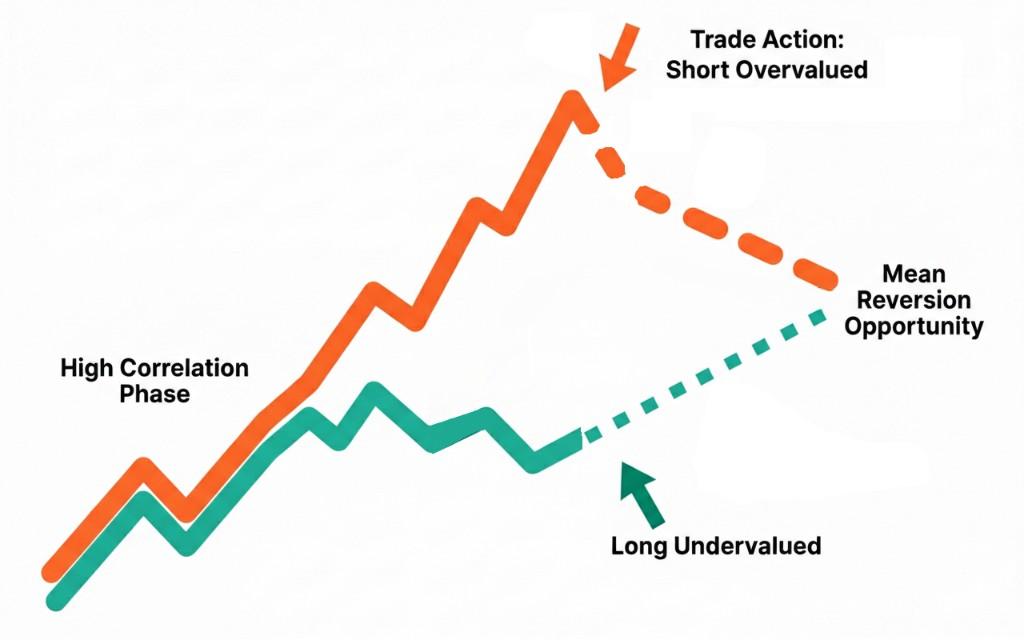
Pair trading is a market-neutral strategy: you don't have to guess or worry about the direction of the overall market. You trade two historically correlated stocks when their prices diverge, going long the undervalued one and short the overvalued one, and profit when the spread reverts toward its mean.
Market Neutrality
Profit in all market conditions with pair trading strategies that remain profitable whether markets rise, fall, or stay flat.
Cointegration Analysis
Discover statistically significant relationships between stock pairs for strategic trading opportunities.
Similarity Rating
Profile-based similarity in business model, sector, and fundamentals supports the trade case—not just statistics.
Screener preview loads when you scroll here.
Why Choose PairParade for Stock Market Analysis?
Advanced Statistical Analysis
Our platform uses sophisticated cointegration testing and statistical models to identify meaningful relationships between stocks. This quantitative approach helps you make data-driven investment decisions rather than relying on intuition alone.
User-Friendly Design
Unlike complex institutional tools, PairParade translates advanced financial concepts into clear, actionable insights that you can understand and implement in your trading strategy.
Comprehensive Market Coverage
Access data from major exchanges including NYSE, NASDAQ, and international markets. Our platform covers thousands of stocks, ETFs, and other securities, giving you the breadth of data needed for effective pair trading strategies.
Risk Management Tools
Built-in risk assessment features help you understand the potential downside of your trading strategies. Our tools provide position sizing recommendations and risk metrics to help protect your capital while maximizing opportunities.
Pairs Trading FAQ
What is pairs trading?
Pairs trading is a market-neutral approach where you buy one stock and short a related stock, targeting profits from mean reversion in their relative price (the spread/ratio).
What is cointegration (and why does it matter)?
Cointegration is a statistical relationship that can indicate a stable long-run connection between two price series. It’s commonly used to justify mean-reversion assumptions in pairs trading.
How do z-scores help with entries and exits?
A z-score tells you how far today’s spread/ratio is from its historical mean in standard deviations. Many traders enter when |z| is high and exit as it returns toward 0.
Is pairs trading risk-free?
No. Relationships can break down, volatility can change, and shorting adds its own risks. Use position sizing, stops, and diversification.
Where can I learn the basics step-by-step?
Start on the Learn hub and the guides on cointegration screening and z-score calculation.